
AI Token Price Normalization
It is possible but takes work!!!

By
Dr. Howard A. Rubin
Professor Emeritus City University of New York
Founder, www.techeconomists.com
August 4, 2026
Abstract
In many ways tokens are analogous to CPU cycles—not business value. Just as organizations no longer choose servers solely by CPU clock speed, AI providers should not be selected solely on price per million tokens. The meaningful unit of comparison is the cost to produce a verified business outcome with acceptable quality, speed, and risk.
This outcome-based normalization lets you compare closed and open models, hosted and self-managed deployments, and providers with different tokenization schemes on a common economic basis.
Some Background on the Wisdom of Comparing Token Prices
This is one of the biggest mistakes enterprises are making.
Comparing token prices is like comparing airlines by the price of jet fuel. The token is not the economic unit that matters—the business outcome is.
The problem is that every AI provider has different:
Tokenization algorithms (same document = different token counts)
Context window sizes
Pricing (input, output, cache, reasoning, embeddings)
Model quality
Reasoning depth
Latency
Error rates
Tool calling behavior
Retry rates
As a result, $1 per million tokens at one provider is not equivalent to $1 per million tokens elsewhere. A better normalization approach:
I recommend normalizing around what I would call an Equivalent Intelligence Unit (EIU) from my Technology Economics perspective. Instead of comparing token costs, compare:
Cost to successfully complete the same workload.
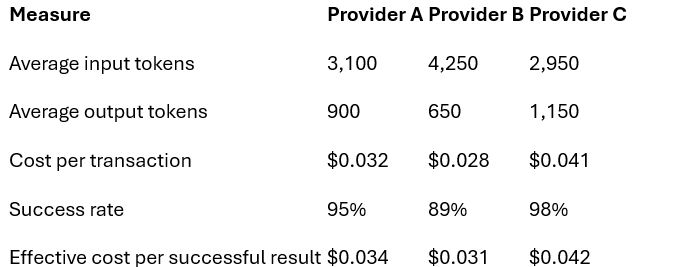
Notice that the cheapest token price may not produce the lowest business cost.
Step 1 Normalize by work
Take a standard workload.
For example:
Summarize a 40-page document
Review a loan application
Produce code
Analyze a legal contract
Customer service interaction
Run identical prompts against every model.
Measure
Total input tokens
Total output tokens
Runtime
Retries
Tool calls
Human corrections
This becomes your baseline.
Step 2 Calculate Effective Token Cost
Instead of
Cost / Tokens
calculate
Cost / Successful Task
For example
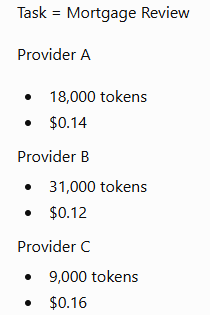
If Provider C finishes faster and correctly the first time, it may be the least expensive overall despite the highest token rate.
Step 3 Normalize for quality
Introduce a Quality Score.
Example
Quality Index
Accuracy
Hallucinations
Completeness
Consistency
Regulatory compliance
Score each 1–100.
Then compute
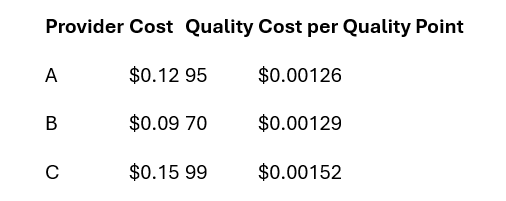
Now you are comparing economics rather than pricing.
Step 4 Normalize for latency
Many enterprise applications value speed.
Compute
Cost × Response Time
Example
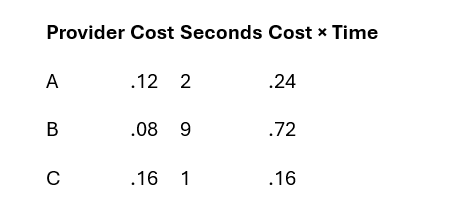
Sometimes paying more is economically superior.
Step 5 Normalize for productivity
Measure
Hours saved per dollar
Example
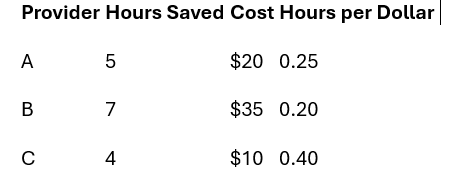
This is often the metric CFOs care about.
Step 6 Normalize for compute efficiency
Measure
GPU seconds
Energy
Memory
Infrastructure utilization
This becomes important when running open models internally.
My preferred enterprise metric
One metric I’ve found especially useful is my AI Technology Economics Index (ATEI):

Where Total Cost includes:
Token charges
GPU costs
Human review
Orchestration
Network
Storage
Prompt engineering
Monitoring
Retraining
Compliance
Security
Vendor licensing
Higher scores indicate more economic value delivered per dollar spent.
Now for a “ Rubin-style” normalization framework
This aligns with a Technology Economics approach by moving beyond infrastructure metrics to business outcomes. A practical scorecard could include:
Dimension/Weight
Business outcome achieved 25%
Effective cost per successful task 20%
Accuracy and quality 20%
Latency 10%
Human intervention required 10%
Security and governance 10%
Vendor lock-in/flexibility 5%
This produces a Provider Value Index (PVI) rather than a simple token price comparison.
Conclusion : The key insight
Tokens are analogous to CPU cycles—not business value. Just as organizations no longer choose servers solely by CPU clock speed, AI providers should not be selected solely on price per million tokens. The meaningful unit of comparison is the cost to produce a verified business outcome with acceptable quality, speed, and risk.
This outcome-based normalization lets you compare closed and open models, hosted and self-managed deployments, and providers with different tokenization schemes on a common economic basis.