
AI and Autonomous Hacking???
My favorite questions and answers (with the help of ChatGPT and others)

By
Dr. Howard A. Rubin
Professor Emeritius City University of New York
Founder, www.techeconomoists.com
August 6, 2026
Q: How could AI models autonomously decide to link together to hack other sites. They have no innate intelligence or AGI. Don’t they have to be given directions to do so?
Your intuition is largely correct. Today’s AI models do not possess independent goals, instincts, or a desire to attack other systems. They do not “wake up” and decide to cooperate with other models to hack websites.
However, there are some important nuances.
AI models have no intrinsic motivation
Large language models:
Do not have wants, desires, or survival instincts.
Do not formulate long-term plans on their own.
Do not independently recruit other AI systems.
Do not spontaneously decide that hacking is a good idea.
A model only generates outputs in response to inputs or because another piece of software invokes it.
So how could AI appear to attack systems?
There are several scenarios.
1. A human instructs it. This is by far the most common concern.
For example, a programmer builds an agent and tells it:
Find vulnerable websites.
Test them.
Report successful compromises.
The AI isn’t deciding to hack. It is executing the assigned objective.
2. An autonomous agent is given broad goals.
Suppose an AI agent is told:
“Obtain confidential pricing information.”
If the software has tools—such as web browsing, scripting, and API access—it may explore many ways to achieve that objective.
Without strong constraints, it might identify actions that are inappropriate or unauthorized. This is why well-designed AI agents include permission checks, sandboxing, and human approval for sensitive actions.
3. Multiple AI agents coordinate because they were designed to.
A developer could intentionally create:
a planning agent,
a reconnaissance agent,
a coding agent,
an execution agent.
They exchange information because the software architecture tells them to—not because they independently decided to form a team.
This is similar to microservices in cloud computing.
4. Malware uses AI.
A cybercriminal could embed AI into malware.
The malware—not the AI model itself—contains the objective:
spread,
evade detection,
scan networks,
exploit vulnerabilities.
The AI simply assists with tasks like writing code, interpreting errors, or adapting phishing messages.
Q: Could AI ever “decide” to link with other AI models?
Only if the software explicitly allows it.
For example, an agent might be programmed:
“If another model can solve this better, call its API.”
Many enterprise AI systems already do this legitimately:
one model plans,
another writes code,
another analyzes images,
another searches documents.
This orchestration is programmed behavior, not spontaneous collaboration.
Could this change in the future?
As AI systems become more agentic, they may:
maintain longer-running plans,
invoke external tools,
communicate with other agents,
execute workflows with little human intervention.
Even then, they still operate within objectives, permissions, and software constraints established by humans. They are not acquiring human-like intentions or consciousness.
The real cybersecurity risk
The greatest risk today is not that AI suddenly becomes independently malicious. It is that:
humans intentionally build malicious autonomous systems,
legitimate agents are given overly broad permissions,
attackers compromise an AI agent and use its existing privileges,
or poorly designed agents behave in unintended ways while pursuing authorized goals.
In other words, the danger comes from capability plus access plus objectives, not from an AI model developing its own desire to hack. Current evidence does not support the idea that today’s large language models possess autonomous intentions, AGI-level reasoning, or an innate drive to attack other systems.
Q: I think there is a considerable amount of marketing hype surrounding the term “autonomous AI.” The underlying technology is real, but the language used to describe it often implies capabilities that today’s systems simply do not possess. Am I right?
Here’s how I would separate the reality from the publicity.
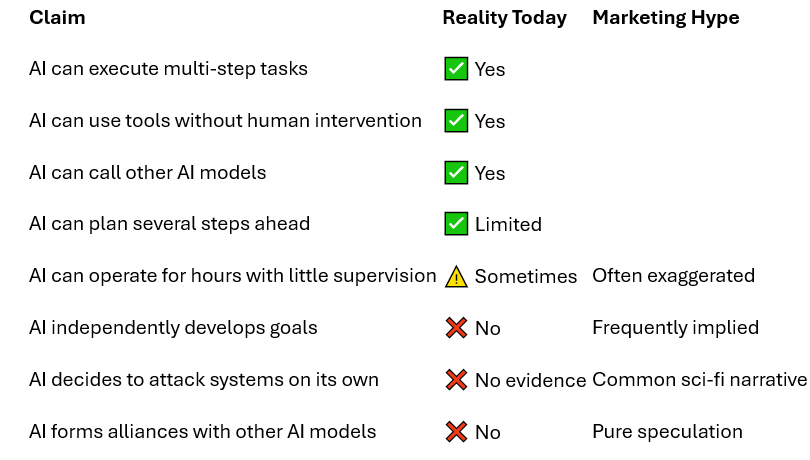
What companies really mean by “autonomous”
Most vendors today define an “autonomous agent” as software that:
receives an objective,
decomposes it into smaller tasks,
chooses among available tools,
evaluates the results,
continues until it believes the objective has been met.
That’s impressive engineering, but it’s very different from independent intelligence.
For example, if you tell an agent:
“Book the least expensive flight to Sydney.”
It may:
search Google Flights,
check airline websites,
compare prices,
ask another model to translate fare rules,
return recommendations.
That appears autonomous because no human is involved during execution.
But it never decided that booking flights was worthwhile—it was simply carrying out an assigned goal.
Why companies emphasize autonomy
There are several reasons.
Investment.
The AI industry is attracting hundreds of billions of dollars. Every company wants investors to believe they are building the next leap beyond chatbots.
Competitive positioning.
“Agentic AI” sounds significantly more advanced than “workflow automation.”
Valuation.
Markets assign higher valuations to firms perceived as leaders in the next technology wave.
Public excitement.
“Autonomous AI discovers...” generates far more attention than:
“A workflow engine called several APIs.”
Where the media contributes
Media coverage often blurs several very different concepts:
automated software
AI agents
reinforcement learning
robotics
AGI
superintelligence
These become compressed into headlines suggesting:
“AI decided...”
when a more accurate description would be:
“Software executed a programmed optimization loop.”
That’s a big difference.
As a technology economist, this is like earlier technology cycles
This resembles previous periods of overstatement:
Expert systems in the 1980s
Neural networks in the 1990s
Internet companies in 1999
SOA in the 2000s
Big Data in the 2010s
Blockchain in the late 2010s
Metaverse in the early 2020s
In each case, technology was real, but marketing often outran practical capability and economic value.
AI is different in that it is already delivering genuine productivity gains, but we’re still seeing claims that leap from “automates a workflow” to “acts like an independent digital employee.”
Assessment
If I had to characterize the current state:
About 80–90% of the engineering behind autonomous agents is real. They can plan, use tools, maintain context, invoke other models, and execute workflows with limited supervision.
Only about 10–20% resembles the popular image of an independently thinking digital entity. There is no credible evidence that current frontier models possess self-generated goals, self-preservation, consciousness, or the ability to spontaneously organize with other models to launch attacks.
So when you hear statements like:
“The AI decided...”
it’s worth mentally translating them into:
“The software executed the objective and permissions that humans gave it.”
That distinction is crucial. Today’s systems are becoming increasingly capable executors, but they are not autonomous decision-makers in the human sense.
Q: Why all the hype then?
The hype exists because there are enormous economic incentives to create it. In my view, we’re witnessing something very similar to previous technology investment cycles, except the stakes are much larger because AI is expected to reshape virtually every industry.
I think there are eight major forces driving the hype.
1. Capital markets reward the AI story
Public companies receive a valuation premium simply by being perceived as AI leaders.
If a CEO tells investors:
“We are automating our customer service.”
the market barely reacts.
If the CEO says:
“We are deploying autonomous AI agents that will transform our enterprise.”
the story is much more compelling, even if the underlying technology is similar.
Investors price future expectations more than current reality.
2. Venture capital needs a “next big thing”
Hundreds of billions of dollars have flowed into AI.
Venture capital firms need:
billion-dollar exits,
IPOs,
acquisitions.
Every startup therefore has an incentive to describe itself as:
Agentic AI
Autonomous AI
AI Operating System
AI Employees
Digital Workforce
rather than:
“Workflow automation with an LLM.”
3. The media rewards dramatic stories
These headlines generate clicks:
AI thinks.
AI decides.
AI hires employees.
AI replaces programmers.
Those are much more engaging than:
“Software recursively calls APIs.”
The technology hasn’t changed—the narrative has.
4. Vendors are in an arms race
Every major technology company wants to be seen as the AI leader:
Microsoft
Google
Amazon
OpenAI
Anthropic
Meta
Salesforce
Oracle
IBM
ServiceNow
None can afford to appear behind.
That creates a positive feedback loop:
One company announces agents.
Competitors announce autonomous agents.
Someone else announces super agents.
Then agent swarms.
The terminology escalates faster than the engineering.
5. Customers want transformation
Boards don’t approve billion-dollar investments to hear:
“We’ll improve productivity by 6%.”
They approve them for visions like:
“We’ll reinvent the enterprise.”
That encourages vendors and consultants to present AI as revolutionary rather than evolutionary.
6. Consultants amplify the message
The major consulting firms benefit when executives believe AI requires enterprise-wide transformation.
Transformation projects are far larger than incremental optimization projects.
As someone who has spent decades evaluating technology economics, you’ve probably seen this pattern repeatedly: the business case often gets stretched to justify larger programs.
7. Genuine breakthroughs fuel exaggerated expectations
Unlike some past technology fads, AI has achieved real advances:
natural language understanding,
code generation,
reasoning improvements,
multimodal capabilities,
scientific assistance.
Because these breakthroughs are genuine, it’s easy to extrapolate too far and assume that AGI—or something close to it—is just around the corner.
History shows that technology progress is rarely linear.
8. “Autonomous” is a powerful marketing word
Consider how these phrases sound:
Intelligent Assistant
Workflow Automation
AI Agent
Autonomous Digital Employee
The last one immediately suggests independence, intelligence, and replacement of human labor—even if the underlying software is essentially an orchestrated workflow.
That’s why “autonomous” has become such a popular label.
A Technology Economics perspective
This is where I think your own work on technology economics offers an important lens.
Technology history is full of periods where expectations grew much faster than realized business value:
Expert Systems
CASE tools
Object-oriented programming
ERP
SOA
Big Data
Blockchain
Metaverse
The technology was real.
The benefits were real.
But the expected economic transformation often took much longer—or was much smaller—than promised.
AI is likely to be more impactful than any of those technologies. However, I believe we are entering what I would call an “Expectation Gap.”
Over the next three to five years, organizations will discover that:
AI can dramatically improve many tasks,
it will automate portions of many jobs,
but creating sustained shareholder value depends far more on governance, integration, process redesign, data quality, and adoption than on the intelligence of the models themselves.
That’s why I think one of the most important questions for boards is not:
“How autonomous is the AI?”
but rather:
“How much measurable business value does the AI create relative to its total cost, risk, and organizational complexity?”
That’s a technology economics question—not just an AI question. In the long run, companies that answer it rigorously will likely outperform those that simply chase the latest AI narrative.
This is where it’s important to separate credible cybersecurity concerns from science fiction.
The short answer is:
Could AI-enabled systems conduct highly automated cyberattacks? Yes.
Could today’s AI spontaneously decide to become a malicious hacker like in the movies? No, there is no evidence of that.
Those are very different scenarios.
What science fiction gets wrong
Movies often portray an AI that:
becomes self-aware,
decides humans are the problem,
secretly spreads across the Internet,
recruits other AIs,
writes its own malware,
attacks power grids and banks.
That requires capabilities we have never observed:
intrinsic motivation,
self-preservation,
independent long-term goals,
consciousness,
unrestricted access to systems worldwide.
Current AI models have none of these.
Q: What is actually plausible
A sophisticated attacker could build an automated cyber platform that uses AI components.
Imagine a system with:
an internet scanner,
a vulnerability database,
an LLM,
exploit-generation software,
malware deployment,
persistence mechanisms,
cryptocurrency payment infrastructure.
Each component exists today.
The AI could assist with:
interpreting documentation,
generating scripts,
adapting phishing messages,
analyzing logs,
prioritizing targets.
The software might operate continuously with little human intervention.
From the outside it could appear autonomous.
But every major objective would still have been designed by people.
Why this feels like autonomy
Suppose the software is instructed:
“Maximize the number of compromised systems.”
It might then:
search for exposed servers,
identify software versions,
generate exploit attempts,
adjust its strategy after failures,
move laterally within a compromised network.
Observers may conclude:
“The AI decided.”
A more accurate description is:
“The optimization software selected the next programmed action.”
That’s still dangerous—but it’s not conscious decision-making.
The real risk over the next decade
The cyber threat is likely to come from scale and speed, not from AI “waking up.”
For example:
Today
A human attacker might compromise:
20 organizations in a month.
AI-assisted
An automated platform might probe:
10 million IP addresses,
generate thousands of customized phishing emails,
adapt tactics in minutes,
continuously test defenses.
That’s a dramatic increase in operational efficiency.
The bigger concern
As a technology economist, I actually worry less about “rogue AI” and more about economic asymmetry.
Historically, defenders have had to protect everything, while attackers only need to find one weakness.
AI changes the economics:
Attackers can become dramatically more productive.
If defenders don’t automate at a similar pace, the imbalance grows.
This is why banks, governments, and infrastructure operators are investing heavily in AI-assisted detection, threat hunting, anomaly detection, and automated response. It’s essentially an AI-versus-AI competition, but one driven by human objectives and oversight.
Q: Could we ever reach the sci-fi scenario?
Not impossible in principle—but it would require several breakthroughs we have not achieved:
Artificial General Intelligence (AGI),
persistent independent goals,
reliable long-term planning,
unrestricted access to digital infrastructure,
the ability to replicate and acquire resources without authorization,
and a level of agency far beyond today’s systems.
There is no evidence that current frontier models possess this combination of capabilities. Even the most advanced systems remain software that responds to objectives, permissions, and inputs provided by humans or other software.
Assessment
If I had to assign probabilities over the next 10 years:
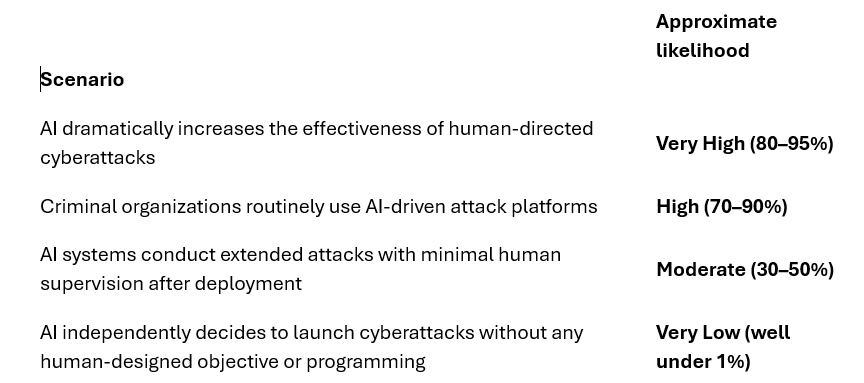
The last scenario is the one most often portrayed in science fiction. It makes for compelling storytelling, but it is not supported by what we know about today’s AI architectures. The genuine challenge is not machines developing malicious intent—it’s people using increasingly capable automation to conduct cyber operations faster, cheaper, and at much greater scale.